

Skip to content
Anruda Textile
SUSTAINABLE MATERIAL GUIDE

What Are Sustainable Activewear Fabrics?

Sustainable activewear fabrics combine recycled, bio-based or responsibly sourced materials with the stretch, recovery, durability and comfort required for sportswear.

The right material should be selected according to the garment application, target performance, certification requirements and bulk-production feasibility—not by fiber name alone.

Anruda supports sportswear brands with material selection, custom knitting, functional finishing, fabric testing and documentation for selected sustainable fabric programs.

EXPLORE ECO-FRIENDLY FABRICS
textbg02
TENCEL Modal fabric for soft activewear and athleisure

TENCEL™ Modal Fabrics

    TENCEL™ Modal fibers are derived from certified or controlled wood sources and produced using a resource-efficient modified viscose process with high chemical recovery rates.

    Known for their long-lasting softness, smooth hand feel and drape, TENCEL™ Modal fibers can be blended with performance yarns for yoga wear, athleisure, intimates and other next-to-skin apparel.

    For activewear development, the final blend, fabric construction, dimensional stability and care performance should be confirmed through sample testing.

TENCEL Lyocell fabric for breathable activewear

TENCEL™ Lyocell Fabrics

   TENCEL™ Lyocell fibers are derived from certified or controlled wood sources and produced through a closed-loop process in which more than 99.8% of the solvent is recovered and returned to the production loop.

  The fibers provide softness, breathability, moisture absorption and skin comfort, making them suitable for yoga wear, athleisure, base layers and selected activewear applications.

 Because activewear performance depends on the complete fabric structure, buyers should also confirm blend composition, stretch and recovery, abrasion resistance, pilling resistance and dimensional stability.

TENCEL™ is a trademark of Lenzing AG.

Sorona bio-based stretch fabric for sportswear

Sorona® Fabrics

 Sorona® is a high-performance polymer containing 37% renewable plant-based ingredients by weight.

  It can provide softness, stretch and recovery, durability and shape retention, making it suitable for yoga wear, athleisure, swimwear and other garments that require comfort and freedom of movement.

 According to Sorona's published life-cycle assessment comparison, production of the polymer uses less energy and generates fewer greenhouse gas emissions than the production of nylon from non-renewable resources.

 Specific functions such as moisture management, UV protection or antibacterial performance should be confirmed according to the final fabric construction, finishing process and test report.

Recycled polyester fabric for running and gym wear

Recycled Polyester Fabric

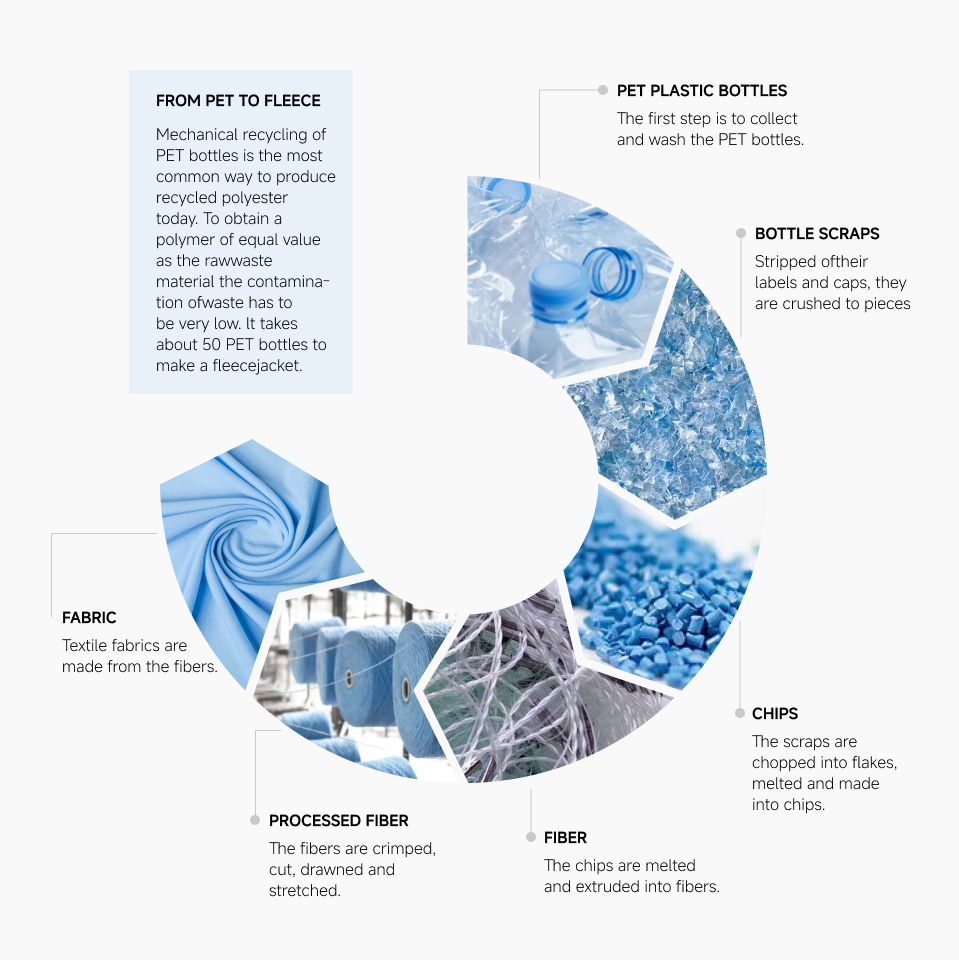
 Recycled polyester is produced from recycled feedstock, most commonly post-consumer PET bottles, and can reduce dependence on virgin fossil-based polyester inputs.

 It can be engineered into lightweight, quick-dry, brushed or high-stretch fabrics for running wear, gym wear, cycling apparel and athleisure.

    The final performance depends on yarn selection, knitted construction and functional finishing. Buyers should verify recycled content, stretch and recovery, colorfastness, pilling resistance, abrasion resistance and dimensional stability before bulk production.

  GRS or RCS documentation may be available depending on the selected material and supply chain. Certification scope and transaction documentation should be confirmed before order placement.

MATERIAL SELECTION GUIDE

Which Sustainable Fabric Is Best for Activewear?

There is no single sustainable fabric that is best for every type of activewear. The most suitable material depends on the garment application, required stretch, moisture management, hand feel, durability, certification requirements and target price.

Compare the primary value, suitable applications and key verification points of recycled polyester, TENCEL™ Modal, TENCEL™ Lyocell and Sorona® before starting sample development.

Comparison of sustainable fabric options for activewear development
Material Primary Value Suitable Applications What Buyers Should Verify
01 Recycled Polyester Durable and versatile material platform for lightweight, quick-dry, brushed and high-stretch fabric development. Running wear, gym wear, cycling apparel, teamwear and performance athleisure. Recycled content, certification scope, stretch and recovery, quick-dry performance, colorfastness, pilling resistance and dimensional stability.
02 TENCEL™ Modal Soft hand feel, smooth surface, drape and next-to-skin comfort. Yoga wear, Pilates wear, athleisure, intimates and other comfort-focused apparel. Fiber blend ratio, stretch performance, pilling resistance, dimensional stability and care performance.
03 TENCEL™ Lyocell Breathability, moisture absorption, softness and skin comfort. Yoga wear, base layers, athleisure and selected low-to-medium-impact activewear. Stretch and recovery, abrasion resistance, wet performance, pilling resistance and dimensional stability.
04 Sorona® Soft stretch, elastic recovery, shape retention and freedom of movement. Yoga wear, fitted athleisure, swimwear and garments requiring comfort and recovery. Blend composition, stretch direction, elastic recovery, colorfastness, dimensional stability and application-specific testing.

For activewear that requires both sustainability and high stretch, recycled, bio-based or cellulosic fibers are often blended with polyester, nylon or elastane rather than used alone. Final performance should be confirmed according to the complete fabric construction and test results.

INTEGRATED SUPPLY CHAIN

From Sustainable Fabric Requirements to Bulk Delivery

Anruda supports activewear brands from requirement confirmation and fabric development through knitting, dyeing or printing, functional finishing, laboratory testing, bulk inspection and final shipment.

Solid-color fabrics proceed through dyeing, while printed fabrics require print approval before bulk printing. Regardless of the selected route, the finished fabric should undergo relevant performance testing and bulk inspection before delivery.

01 STEP 01

Requirements Confirmation

We first confirm the garment application, target composition, performance requirements, sustainability needs and expected production conditions.

  • Product type and end use
  • Target fiber composition
  • Target GSM and fabric width
  • Color and hand-feel requirements
  • Stretch and recovery requirements
  • Certification or documentation needs
02 STEP 02

Fabric Recommendation or Custom Development

Available fabrics are recommended for rapid sampling, while custom fabrics can be developed according to the brand’s product position and technical requirements.

  • In-stock fabric selection
  • Reference-sample analysis
  • Composition and GSM matching
  • Color and texture development
  • Functional performance planning
  • Sustainable material route evaluation
03 STEP 03

Knitting

Knitting construction is developed according to the required fabric weight, stretch, recovery, support, breathability, hand feel and surface appearance.

  • Yarn and composition selection
  • Circular-weft knitting construction
  • Yarn-tension control
  • Fabric take-down control
  • GSM and width stability
  • Surface consistency evaluation
04 STEP 04

Dyeing or Printing

Solid-color fabrics enter the dyeing process. Printed fabrics proceed through print strike-off approval before bulk printing.

  • Lab-dip or color approval
  • Shade accuracy and consistency
  • Stable hand-feel control
  • Print design reproduction
  • Print definition and color consistency
  • Pattern appearance under stretch
05 STEP 05

Functional Finishing

Selected functional finishes can be adjusted according to the final garment application and confirmed project requirements.

  • Moisture-wicking finish
  • Antimicrobial treatment
  • UV-protection finish
  • Water-repellent finish
  • Softening finish
  • Application-specific hand-feel adjustment
06 STEP 06

Laboratory Testing

Relevant laboratory tests are selected according to the fabric application, quality specification and identified production risks.

  • Fabric weight and width
  • Stretch and recovery
  • Colorfastness
  • Pilling and abrasion resistance
  • Shrinkage and dimensional stability
  • Moisture-wicking performance
  • pH and formaldehyde content
07 STEP 07

Bulk Fabric Inspection

Bulk fabric is inspected against the approved standard to help identify visual, dimensional and performance inconsistencies before shipment.

  • Shade variation control
  • Print color and distortion inspection
  • Recovery and knee-bagging risk
  • Shrinkage and pilling risk
  • Bulk-to-sample consistency
  • Documentation completeness
08 STEP 08

Packing and Shipment

After testing and bulk inspection are completed, approved fabrics are packed and prepared for shipment according to the confirmed order requirements.

  • Final quantity confirmation
  • Roll identification and labeling
  • Protective fabric packaging
  • Packing-list preparation
  • Shipment arrangement
  • Retained production references
BEFORE DEVELOPMENT BEGINS

Information That Helps Us Recommend the Right Fabric Direction

The more clearly the intended product and target performance are defined, the more efficiently the fabric route and potential production risks can be evaluated.

01

Product type and end use

02

Target fiber composition

03

Target fabric weight or GSM

04

Color requirements

05

Hand-feel requirements

06

Stretch and recovery requirements

07

Sustainability certification requirements

08

Reference sample availability

QUALITY RISK CONTROL

Testing Is an Integral Part of Supply Chain Reliability

A fabric sample may feel suitable, but that alone does not guarantee stable bulk production. Laboratory testing, production control and bulk inspection help identify shade variation, print distortion, insufficient recovery, shrinkage, pilling and documentation risks before delivery.

VERIFIED CERTIFICATIONS

Certifications and Compliance Support

Verified quality management, product safety and recycled-material traceability support for selected activewear fabric programs.

Certification coverage depends on the selected composition, fabric specification and production route. Click each certificate image to view the corresponding full-size document.

PRODUCT SAFETY CURRENT

OEKO-TEX® STANDARD 100

Selected polyester-elastane and polyamide-elastane knitted fabrics are certified according to OEKO-TEX® STANDARD 100.

Product Class
Class II — products with direct contact to skin
Covered Products
Selected polyester/elastane and polyamide/elastane knitted fabrics, including white and specified piece-dyed fabrics
Certificate Number
23.HCN.41617
Valid until 31 May 2027
RECYCLED-MATERIAL TRACEABILITY CURRENT

Global Recycled Standard

Anruda holds a valid GRS scope certificate covering selected recycled nylon-spandex and recycled polyester-spandex knitted fabrics.

Certified Product
Dyed knitted fabrics
Certified Processes
 Knitting, Pre-treatment, Finishing and Dyeing
Scope Certificate Number
CTI-SZA30973-02-GRS-2026-0616
MATERIALS LISTED IN THE CERTIFICATE
  • 80% recycled pre-consumer nylon + 20% elastane
  • 75% recycled pre-consumer nylon + 25% elastane
  • 70% recycled pre-consumer nylon + 30% elastane
  • 80% recycled post-consumer polyester + 20% elastane
Valid until 28 August 2027
QUALITY MANAGEMENT CURRENT

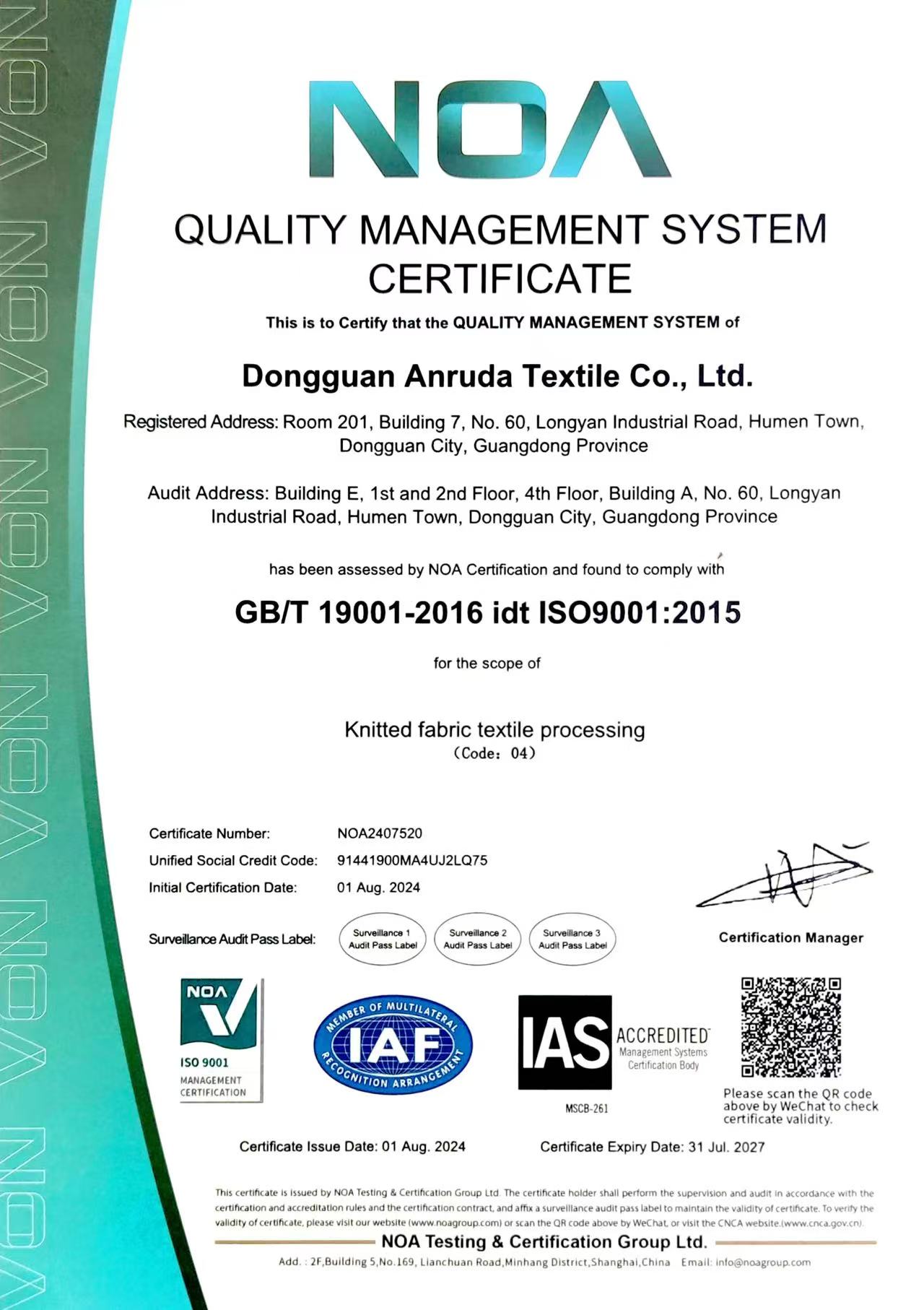
ISO 9001:2015

Anruda’s quality-management system for knitted fabric textile processing is certified according to ISO 9001:2015.

Certification Scope
Knitted fabric textile processing
Applicable Standard
GB/T 19001-2016 / ISO 9001:2015
Certificate Number
NOA2407520
Valid until 31 July 2027

Certification Scope Should Be Confirmed for Each Project

A certificate does not automatically cover every fabric, composition or production order. OEKO-TEX® coverage should be confirmed against the selected fabric specification. For GRS-related orders, transaction-level proof should be supported by an applicable Transaction Certificate or equivalent documentation.

FREQUENTLY ASKED QUESTIONS

Sustainable Activewear Fabric FAQs

Practical answers for activewear brands comparing recycled, bio-based and responsibly sourced fabric options for product development and bulk production.

01 What is the best sustainable fabric for activewear?

There is no single sustainable fabric that is best for every activewear product. The right option depends on the garment application, stretch requirements, hand feel, moisture management, durability, target price and production volume.

Recycled polyester is often selected for running, gym wear and quick-dry applications. TENCEL™ Modal and Lyocell may be considered when softness and skin comfort are priorities, while Sorona® may be used when soft stretch and shape recovery are required.

02 Is recycled polyester suitable for high-performance activewear?

Yes. Recycled polyester can be developed for running apparel, training wear, gym clothing, cycling products and performance athleisure.

However, performance depends on the yarn quality, knitted construction, fabric weight, dyeing and finishing—not only on the recycled fiber label. The finished fabric should be evaluated for stretch, recovery, colorfastness, pilling, abrasion resistance and dimensional stability before bulk production.

03 What is the difference between TENCEL™ Modal and TENCEL™ Lyocell?

Both are regenerated cellulosic fibers made from wood-based raw materials, but they use different production processes and can provide different fabric characteristics.

TENCEL™ Modal is commonly selected for softness, smooth hand feel and drape. TENCEL™ Lyocell is often selected for breathability, moisture absorption and skin comfort. Final activewear performance still depends on the blend ratio, fabric construction and finishing process.

04 Is Sorona® a fully plant-based fiber?

No. Sorona® should not be described as a fully plant-based fiber. It contains renewable plant-based ingredients as part of its polymer composition.

In activewear fabrics, Sorona® may help provide softness, stretch, elastic recovery and shape retention. The exact performance should be confirmed according to the final fabric blend and test results.

05 Can sustainable activewear fabrics include elastane?

Yes. Recycled polyester, recycled nylon, TENCEL™ fibers and other material options may be blended with elastane when additional stretch, close-to-body fit and elastic recovery are required.

The elastane percentage should be selected according to the intended garment. Yoga leggings, sports bras and fitted swimwear typically require a different stretch structure from running tops or lightweight training apparel.

06 Can Anruda customize the composition, GSM, color and finish?

Custom development can include fiber composition, yarn combination, knitted construction, fabric weight, width, stretch direction, color, hand feel, surface texture and selected functional finishes.

Before development begins, buyers should provide the product type, intended application, target composition, GSM, stretch requirements, color direction, estimated quantity and any available reference sample.

07 What should be tested before sustainable fabric bulk production?

Testing should be selected according to the garment application and target market. Common checks include fabric weight, width, stretch and recovery, colorfastness, pilling resistance, abrasion resistance, shrinkage and dimensional stability.

Selected projects may also require moisture-management testing, pH, formaldehyde content or application-specific tests. Testing should be carried out on the finished fabric because dyeing, printing and finishing may change its final performance.

Explore our activewear fabric quality control system
08 Can I request sustainable activewear fabric swatches?

Yes. You can send Anruda your product application, preferred composition, GSM, hand feel, stretch requirements, color direction and estimated quantity.

Our team can review available in-stock options or determine whether a custom fabric development route is more suitable for your project.

Send us your fabric requirements
SUSTAINABLE FABRIC DEVELOPMENT

Develop Sustainable Activewear Fabrics for Your Brand

Tell us your product application, target composition, performance requirements and sustainability goals. Our team will help identify suitable fabric options for sampling, testing and custom development.

Recycled and alternative material options

Custom composition, GSM, color and finish

Performance testing and bulk-production support

REQUEST SUSTAINABLE FABRIC OPTIONS

Share your reference fabric, product brief or target specification to help us recommend the next development step.

Leave Your Message