



What Is Ribbed Activewear Fabric? A Selection and Sourcing Guide for Yoga Sets
As athleisure grows in popularity, activewear is placing greater emphasis on appearance and everyday styling alongside comfort and performance. With its distinctive surface texture, ribbed activewear fabric offers more design options for yoga sets.
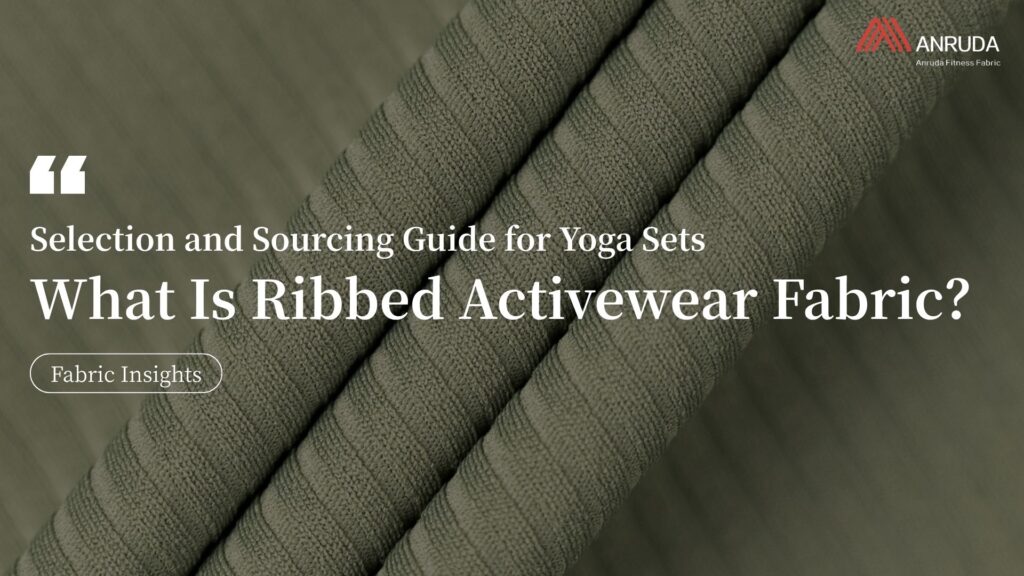
So, how do you choose the right ribbed fabric for yoga wear? Start by understanding the characteristics of its construction, then assess its actual performance in relation to the intended style, usage scenarios, and garment wear requirements.
I. What Is Ribbed Activewear Fabric?
Ribbed activewear fabric generally refers to rib-knit fabric used in activewear. Traditional weft-knitted rib consists of alternating face and reverse stitch wales, creating a continuous raised and recessed vertical texture. It typically offers good crosswise extensibility, and its edges are less prone to curling when the structure is balanced.
The differences between ribbed fabrics and conventional smooth-surface activewear fabrics go beyond surface texture. Visually, ribbed fabrics have a distinctive, three-dimensional vertical texture that also creates a lengthening, slimming effect, while smooth fabrics have an even, clean surface with a simple, understated style and greater visual uniformity. In terms of touch, the feel of ribbed fabrics against the skin is influenced by the raised and recessed texture, yarn specifications, and finishing, allowing for a wide range of tactile effects. The feel of smooth fabrics is mainly influenced by the yarn, fabric density, and finishing, resulting in a uniform, consistent feel against the skin. Under stretch, the ribs open out and the texture becomes less pronounced, making changes in color depth more likely, whereas smooth fabrics offer relatively greater stability in color and appearance. In garment development, ribbed fabrics require tighter control of rib direction, pattern-piece symmetry, and pattern alignment at seams, placing greater demands on manufacturing.
Two common basic rib constructions are used in yoga wear development: 1×1 rib, in which single face and reverse stitch wales alternate, has a fine texture and a close fit, and is often used for sports bra underbands, leg-opening finishes, and close-fitting base layers; 2×2 rib, in which pairs of face and reverse stitch wales alternate, offers a good balance of texture and stretch and is suitable across yoga set categories, combining a comfortable fit with a distinctive appearance.
II. Stretch Characteristics: Key Criteria for Selecting Ribbed Fabrics
Ribbed fabrics should not be judged solely by their texture in a relaxed state. Their texture, opacity, and recovery after stretching are all important factors in how a yoga set looks and performs when worn.
When traditional rib is stretched crosswise, the stitch wales that were originally close together gradually spread apart, exposing some of the previously hidden reverse stitches. The width of the ribs, the degree of surface relief, and the light-and-dark effects also change. Fabric selection should therefore include not only an assessment of the texture and hand feel in the naturally relaxed state, but also a comparison of texture and color under the intended wearing conditions. Localized changes should be checked during movements such as squatting, bending, and raising the legs. The same fabric may display different textures when used for a loose-fitting top and fitted leggings.
The yarn density in the recessed areas of ribbed fabric is inherently lower than in the raised areas. Crosswise stretching further enlarges the gaps between fibers, making underlying yarns or white spandex cores more likely to show through. This can cause whitening and uneven color, detracting from the garment’s appearance. Unlike smooth fabrics with more stable coverage, ribbed fabrics also become more transparent as they stretch. A fabric that is opaque at rest may reveal skin or the outlines of undergarments as its loops open under stretch. During fabric evaluation, distinguish between the intentional light-and-dark effects of the texture and undesirable whitening under stretch, and assess all of these aspects in the stretched state. Light colors, nude shades, and lightweight fabrics are more prone to whitening and show-through and require particular attention. For dark fabrics, also check colorfastness and whitening after stretching.
In addition to appearance and opacity under stretch, elastic recovery is key to the garment’s long-term wear performance. Ribbed fabric must not only stretch but also recover. Otherwise, repeated wear may leave residual deformation at the knees, seat, or waistband, affecting the fit.
III. Selecting Ribbed Fabrics for Different Parts of a Yoga Set
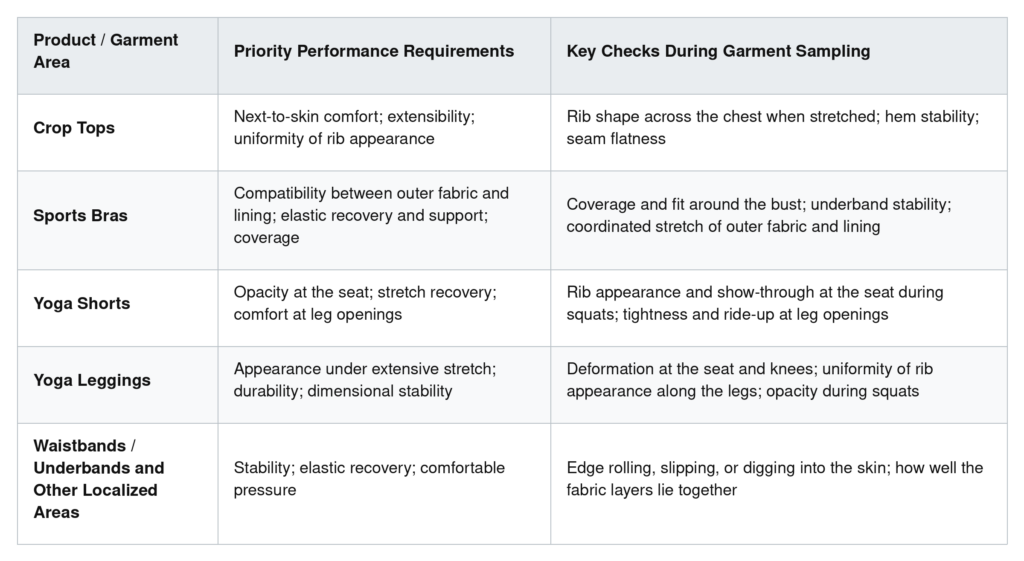
Different parts of a yoga set have significantly different stretch levels and functional requirements. Ribbed fabrics should be selected accordingly, with tops and bottoms evaluated separately. Within a coordinated color palette, fabric weight and rib texture can be adjusted to balance a consistent appearance with wearing performance.
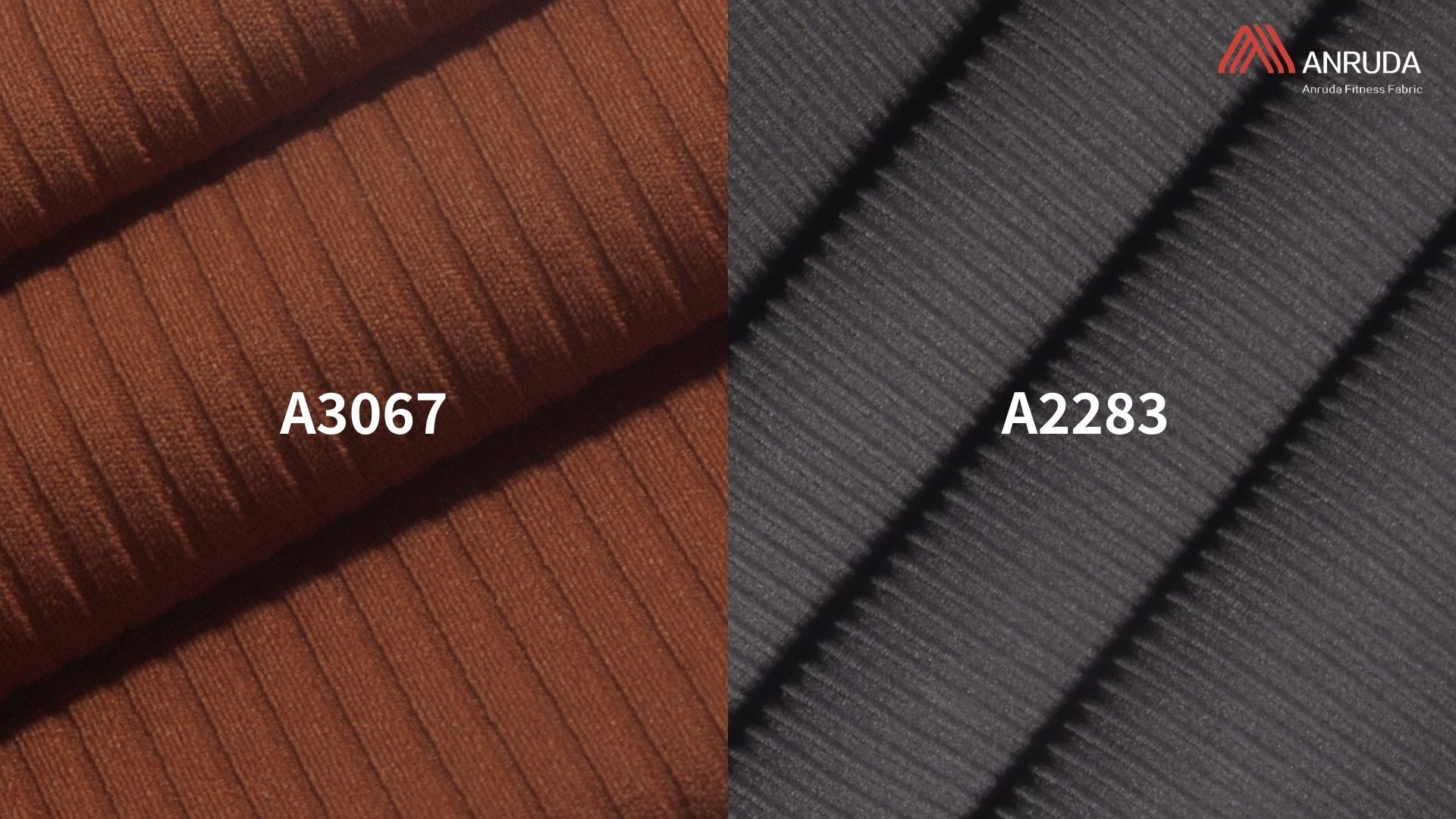
Take Anruda’s A3067 ribbed nylon-spandex activewear fabric as an example. It contains 80% nylon and 20% spandex, weighs 215 g/m², and has a finished width of 135 cm. It can be considered as a sample fabric for developing yoga tops, activewear tank tops, and coordinated sets. During sampling, focus on how much the ribs open under the intended wearing conditions, and check texture alignment at seams and appearance after washing. To compare different fabric weights and surface effects, A2283 ribbed nylon-spandex fabric can also be included in the sample selection. This fabric contains 75% nylon and 25% spandex, weighs 250 g/m², and has a finished width of 152 cm. With ribbed texture on both sides, it can serve as a development reference for yoga leggings, fitted activewear tank tops, and coordinated styles. When comparing it with A3067, assess thickness, drape, resistance to stretch, opacity, and sewing performance together.
IV. Key Specifications to Verify When Sourcing Ribbed Activewear Fabrics
Fabrics described by the same rib designation may still differ in performance because of variations in yarn, density, and finishing. When sourcing, clarify the following four categories of specifications and establish acceptance criteria using approved reference samples, written specifications, tolerances, and testing requirements.
4.1 Fiber Composition and Yarn Information
Choose the base material of a ribbed fabric according to the product’s positioning. Nylon-spandex rib can be a development option for products emphasizing a refined hand feel and a close, comfortable fit. Polyester-spandex rib can be selected according to cost, color, printing, and athletic performance requirements. Modal/lyocell-blend rib is suitable for casual styles emphasizing softness and drape. When used in close-fitting activewear, its wet-state performance, elastic recovery, and dimensional stability also require attention.
In addition to fiber composition, confirm the yarn specifications. For filament yarns, D denotes the yarn’s linear density in denier, and F denotes the number of individual filaments. Fabric hand feel is also influenced by individual filament fineness, yarn processing, construction, and finishing. If a specific spandex brand is required, state the brand and the relevant requirements in the purchasing specifications.
4.2 Rib Construction and Texture Acceptance Criteria
Confirm whether the fabric uses traditional rib, a rib variation, or another construction that creates a ribbed appearance, and ensure that the actual construction matches the agreed specifications. Purchasing documents should specify the construction, the intended outer-facing side, rib direction, width and spacing, the raised and recessed effect, and rib uniformity. Appearance requirements should also be agreed for both the relaxed state and the intended stretched state. Use a reference sample approved by both parties as the benchmark for appearance and hand feel, together with the necessary dimensional records and tolerances, to facilitate checks when accepting bulk fabric.
4.3 Measurement Requirements for Fabric Weight and Usable Width
The crosswise extensibility of ribbed fabrics can affect measurements of fabric weight and width. Relaxation, conditioning, and measurement procedures should therefore be agreed in advance, and measurements should be taken under the specified conditions without additional stretching. Purchasing specifications should state the fabric weight, width, and their respective tolerances, clarify whether the fabric is supplied open-width or tubular, and establish a consistent basis for calculating usable cutting width, including deductions for unusable edges and other excluded areas.
4.4 Elongation, Recovery, and Resistance to Stretch
Stretch performance should be assessed through both crosswise and lengthwise elongation and elastic recovery, rather than crosswise stretch alone. Ribbed fabrics offer ample crosswise stretch, but lengthwise elongation needs to be controlled to prevent trouser legs from lengthening and waistbands from slipping down. Distinguish between low resistance to stretch, which gives a soft feel and suits low-intensity casual styles, and high elastic recovery, which suits leggings and sports bras. Spandex content is only a reference; stretch performance should be judged by measured test results.
Ribbed activewear fabric combines technical athletic functionality with texture suited to everyday styling, making it a key fabric choice for differentiating yoga sets. Successful selection requires moving beyond the habit of assessing samples only at rest. By controlling stretch performance, suitability for different garment areas, and specification requirements throughout the process, brands can develop durable, high-quality products with consistent on-body results.
To obtain physical swatch cards and detailed test reports for ribbed fabrics in different specifications, or to develop a custom ribbed fabric for your yoga sets, Contacto for a complete fabric selection solution and sampling services.
FAQ: Common Questions About Ribbed Fabrics
Do deeper ribs mean a thicker, more supportive fabric?
Not necessarily. Rib depth is determined by the knitted construction and does not have a strictly positive correlation with fabric weight or support. Some lightweight fabrics with wide ribs have a strong visual texture but are actually thin, offer limited support, and are prone to deformation after prolonged wear. Selection should be based on actual fabric weight and recovery test results, rather than appearance alone.
Why does ribbed fabric look lighter in color when stretched?
This may be related to changes in yarn coverage, light transmission, and light reflection as the construction opens out, or to light-colored spandex or underlying yarns becoming visible. A lighter appearance under stretch does not necessarily mean poor colorfastness. Identify the specific cause first, then make adjustments to the yarn, fabric density, spandex specification and arrangement, or dyeing and finishing, and verify the improvement.
Can the same ribbed fabric be used for both yoga tops and leggings?
Yes, but each application needs to be evaluated separately. A fabric suitable for tops may not meet the opacity and shape-retention requirements of leggings at the seat, knees, and other areas. If one fabric cannot meet both sets of requirements, consider fabrics with different specifications or partial lining, and check the consistency of color and texture across the set.
Does a higher spandex content mean better support in ribbed fabrics?
Not necessarily. Support is also influenced by the spandex specification and arrangement, fabric construction, density, resistance to stretch, and garment construction. Evaluate it using measured test data and garment fit trials, rather than selecting solely by spandex percentage.
How should ribbed activewear fabrics be washed and cared for to maintain their texture and shape?
Gentle washing at low temperatures and avoiding high heat and fabric softeners can preserve texture and stretch over the long term. Machine-wash inside out in cold water on a gentle cycle, and avoid high-temperature tumble drying and prolonged exposure to strong sunlight. Do not use fabric softeners, as they can damage spandex elasticity and the set of the rib texture. Dry flat to reduce texture distortion and garment lengthening.