
 Productos


What Information Should You Include in an Activewear Fabric Inquiry? Specifications, Samples, MOQ, and Lead Time
What information should you provide when requesting a quotation from an activewear fabric supplier?
In most cases, you should specify the end use, fiber composition, fabric weight, width, construction, performance requirements, number of colors, order quantity, and required delivery date. In day-to-day customer communication, incomplete requirements are a common cause of delays in processing inquiries and inaccurate quotations. Vague specifications can lead to pricing discrepancies and repeated clarification, while also affecting sample matching, production scheduling, and quality control during bulk production.
For a professional activewear fabric supplier, four areas require particular attention at the inquiry stage: fabric specifications, sample requirements, minimum order quantity (MOQ), and lead time. Providing complete information helps the supplier determine whether an existing fabric is suitable, select the appropriate production process, prepare an accurate quotation, and confirm the MOQ and production schedule.
1. Fabric Specifications: Define Your Sourcing Requirements Accurately
Fabric specifications form the basis for assessing product suitability, selecting the appropriate manufacturing process, and calculating cost. A complete activewear fabric specification normally includes the end use, fiber composition, finished weight, width, fabric construction, hand feel, performance requirements, finishing processes, color requirements, and test standards. The more complete the information, the easier it is for the supplier to recommend a suitable existing fabric or determine whether custom development is required.
Begin by explaining the intended end product, such as yoga leggings, sports bras, running T-shirts, or cycling apparel. Different garments may require different levels of stretch, recovery, breathability, and abrasion resistance. Yoga leggings, for example, generally require four-way stretch, reliable stretch recovery, good opacity, and dimensional stability after repeated stretching. Lightweight running tops place greater emphasis on breathability, moisture management, quick-drying performance, and next-to-skin comfort. Stating the intended application therefore enables a more accurate recommendation than simply requesting a nylon-spandex fabric.
State the percentage of each fiber as precisely as possible, such as 82% nylon and 18% spandex, or 90% polyester and 10% spandex. If the project requires a particular raw material, include this in the inquiry—for example, nylon 66 yarn, recycled yarn, branded spandex, or a specific functional yarn.
Activewear fabric weight is normally expressed in grams per square meter (g/m² or GSM). The same construction can deliver different thickness, support, breathability, and drape at different weights. Dyeing, heat setting, brushing, and other finishing processes may also affect the final weight. For this reason, use the finished fabric weight as the purchasing and inspection reference, and agree on an acceptable tolerance when confirming the order.
Fabric width directly affects marker planning, cutting yield, and material cost per garment. An inquiry should distinguish between usable width and total width: usable width is the portion available for cutting, while total width includes the selvedges. If the customer uses a specific marker or cutting plan, the target usable width can be provided in advance so that the supplier can assess whether an adjustment is feasible.
Fabric construction affects stretch, support, breathability, surface appearance, and end use. Common activewear constructions include single jersey, interlock or double knit, rib knit, mesh, and jacquard. If the exact construction is not known, provide the garment application, desired hand feel, performance requirements, or a physical reference sample. The supplier can then recommend a suitable construction based on practical development and production conditions.
Describe the desired hand feel and surface effect in specific terms—for example, a naked-skin feel, cotton-like hand, cool touch, dry hand, double-sided brushing, a smooth matte surface, a lightweight construction with good opacity, or a particular texture. If a target fabric already exists, provide a physical sample. A physical swatch allows hand feel and surface appearance to be compared more accurately than written descriptions or photographs alone.
Functional performance is an important part of activewear fabric development. Avoid requesting only a ‘functional fabric.’ Instead, identify the required performance properties and test criteria. Common requirements include moisture management, quick-drying performance, four-way stretch, pilling resistance, UV protection, antibacterial or odor-control performance, breathability, thermal insulation, and chlorine resistance. Where measurable performance targets apply, provide the test method and required rating or result.
Finishing processes directly affect hand feel, appearance, performance, price, and lead time. Common finishes include brushing, raising, hydrophilic finishing, and cooling finishes. If a specific effect is required, provide an original reference sample, effect images, or detailed technical requirements. Some finishing processes may increase the MOQ, sampling cost, and production lead time, so process feasibility should be evaluated before quotation.
Compliance requirements vary by market, brand, and product category. State the destination country or region, intended wearer group, whether the fabric will be in direct contact with the skin, and whether the project requires recycled-content certification, restricted-substance testing,compliance with a brand’s restricted substances list (RSL), or third-party test reports.
2.Fabric Sample Requests: Confirm Fabric Performance and Appearance
Different sample formats are suitable for different approval stages. Selecting the appropriate format for the project’s current stage supports more accurate evaluation, reduces unnecessary resampling, and shortens the approval cycle.
A swatch card or small cutting is mainly used for initial screening. It allows a preliminary review of hand feel, construction, thickness, color, and surface appearance. Because of its limited size, however, it cannot fully replace garment sampling or wear testing.
Sample yardage is primarily used to make a first prototype and assess the fabric during cutting, sewing, and wear. It enables a more complete evaluation of stretch, recovery, opacity, next-to-skin feel, and the appearance and performance of the finished garment.
A lab dip is used to approve a custom color before bulk dyeing. The customer may provide a Pantone reference, physical color standard, or reference sample, and the supplier prepares the lab dip against that target. When approving color, also specify the standard light source, acceptable color difference, and requirements for shade variation between dye lots. This reduces inconsistent color judgments caused by different lighting or viewing conditions.
Performance-test samples are used to verify properties such as moisture management, quick drying, pilling resistance, UV protection, chlorine resistance, colorfastness, and dimensional stability. If specific results are required, provide the test method and target rating in advance. The exact test items, testing timeline, and need for third-party testing should be confirmed according to the product application and destination market.
A bulk-production approval sample is taken at an agreed stage during production to confirm color, hand feel, fabric weight, width, and overall appearance. Once approved by both parties, it can serve as an important reference for subsequent bulk inspection. When necessary, the customer and supplier should each retain an approved reference sample.
3. MOQ Policy: Evaluate Minimum Production Requirements
The MOQ for activewear fabric is not determined by a single operation. It is influenced by knitting, dyeing, finishing, the number of colors, and production losses.
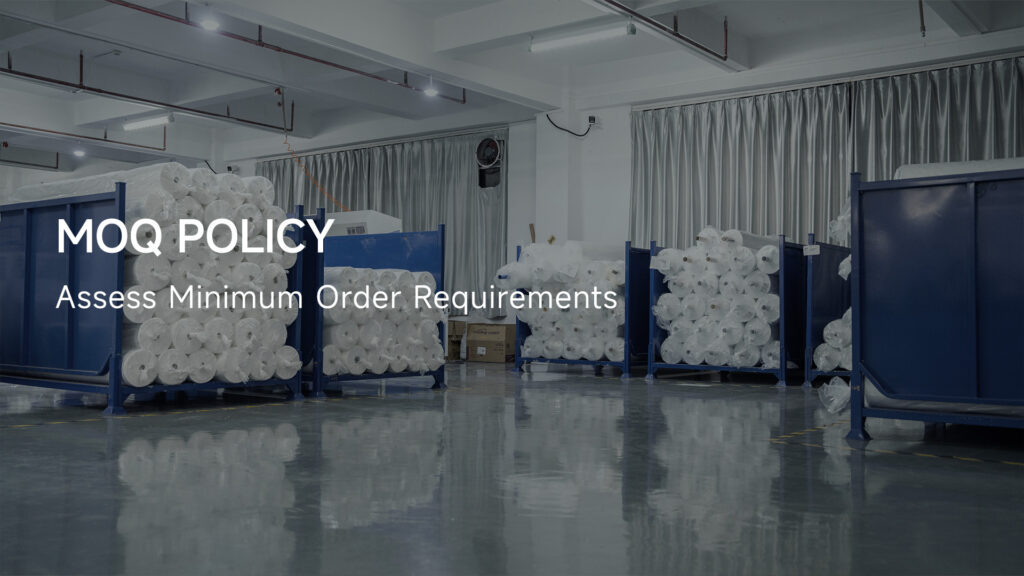
3.1 Greige Fabric Knitting MOQ
Custom greige fabric production requires raw-material preparation, machine setup, start-up losses, and consideration of production efficiency. With a smaller order, fixed production losses are generally allocated across fewer units, increasing the unit cost. If a suitable greige fabric is already held in regular stock, the supplier may be able to avoid a new knitting run, shorten the waiting time, and offer greater flexibility for small-batch development.
3.2 Dyeing MOQ
The dyeing MOQ is generally calculated per color. Each dyeing machine has a suitable batch capacity. When the quantity per color falls below the efficient batch size, small-batch dyeing charges, dedicated-vat charges, or other surcharges may apply. In addition to the total order quantity, specify the quantity per color, total number of colors, whether stock colors are acceptable, and whether dyeing must match a designated color standard.
3.3 Finishing MOQ
Brushing, coating, lamination, printing, jacquard production, and special functional finishes often have separate machine-start requirements and process losses. Their MOQs may therefore be higher than those of standard fabrics. If a project involves several finishing processes, the supplier must evaluate the greige-fabric production threshold, dyeing quantity per color, minimum finishing run, finished-fabric loss, and performance-testing requirements together.
Different sourcing routes can be considered according to the project’s requirements, the selected product, and current inventory. Stock fabrics are well suited to prototype development, small trial orders, and rapid replenishment; available colors, quantities, and dye-lot status must be confirmed against real-time inventory. Some regularly stocked greige fabrics can be dyed to a customer’s color standard, reducing the wait for a new knitting run, although the MOQ must still be assessed per color and against dye-vat capacity. A dedicated dye lot may be suitable when high color consistency is required but the quantity per color is below the normal production batch size; feasibility and any surcharge depend on the specific fabric. Printed, jacquard, or special functional developments are appropriate for brand projects with defined differentiation needs, and the MOQ, screen or engraving charges, sampling fees, and lead time must be evaluated for the specific process.
For start-up brands and market-testing orders, consider stock colors, regularly stocked greige fabrics, or proven fabrics with similar specifications first. These options can reduce development cost and shorten the project timeline.
4. Lead-Time Management: Define the Start Date and Production Process
Production lead time for activewear fabric does not normally begin on the date of the initial inquiry. A clearly defined start point generally requires confirmation of the fabric specifications, color or lab dip, order quantity, packing requirements, contract or purchase order, receipt of the agreed payment, and availability of raw materials and production capacity. The agreed lead-time start point should be recorded in the order-confirmation documents.
What factors can affect lead time?
A complete custom-production project normally includes raw-material preparation, greige-fabric knitting, dyeing, finishing, inspection, packing, and logistics. Yarn availability, production scheduling, process complexity, testing and certification requirements, shipping method, and destination can all affect the final delivery schedule.
To minimize avoidable delays, provide complete specifications and reference samples as early as possible. Confirm the colors, quantity per color, test standards, and target ratings in advance; avoid repeated specification changes during production; and prioritize proven fabrics or regularly stocked greige fabric where appropriate. When conditions allow, garment sampling and selected tests may be arranged in parallel.
5.Activewear Fabric Inquiry Checklist
Before sending an inquiry, buyers can organize the required information using the following checklist.
| Information to Provide | Details to Confirm |
| End use | Yoga leggings, sports bras, running tops, cycling wear, swimwear, or another garment type |
| Fiber composition | Fiber percentages and any yarn requirements, such as nylon 66, recycled yarn, or branded spandex |
| Finished weight | Target g/m² (GSM) and acceptable tolerance |
| Ancho del tejido | Required usable width and, if relevant, total width |
| Construction | Single jersey, interlock/double knit, rib, mesh, jacquard, or reference sample |
| Hand feel and surface | Target hand feel, brushing, matte effect, texture, opacity, and other appearance requirements |
| Performance | Stretch, recovery, moisture management, quick drying, UV protection, pilling resistance, and other targets |
| Acabado | Brushing, raising, cooling, hydrophilic, coating, lamination, printing, or other special processes |
| Colores | Color standards, number of colors, quantity per color, and lab-dip requirements |
| Order quantity | Total quantity and quantity per color |
| Testing and compliance | Test methods, target ratings, destination market, RSL, certification, and third-party testing needs |
| Samples | Swatch card, cutting, sample yardage, lab dip, performance-test sample, or bulk approval sample |
| Required delivery date | Target delivery date, shipping method, and destination |
If some parameters have not yet been finalized, begin with the garment application, reference images, target hand feel, purchase quantity, and required delivery date. The supplier can then help identify the remaining information that needs to be confirmed.
A high-quality activewear fabric inquiry involves more than asking for a price per meter. It should enable the supplier to understand the product application, technical requirements, purchase quantity, and project schedule. Specifications determine whether the fabric and manufacturing process are suitable; samples verify the actual fabric performance and appearance; MOQ affects the production route and cost; and lead time depends on raw materials, processes, testing, and production capacity.
Providing complete information before requesting a quotation reduces back-and-forth communication, improves pricing accuracy, and helps minimize differences between approved samples and bulk production.
If you are developing yoga wear, gym wear, running apparel, cycling wear, swimwear, or other performance activewear, send Anruda your product application, target specifications, reference sample, purchase quantity, and required delivery date. Our team will assess suitable fabric options and development solutions based on your project requirements.
FAQ: Common Questions About Activewear Fabric Inquiries
1. Can I request a quotation if I only have a garment sample and no fabric specifications?
Yes. You may begin by providing the garment sample or a fabric cutting. The supplier can conduct a preliminary assessment of the composition, weight, width, construction, stretch, and hand feel. Final specifications should still be established through testing and written confirmation by both parties.
2. Why must fabric weight and width be confirmed before quotation?
Fabric weight and width affect raw-material consumption, dyeing and finishing costs, price per unit area, and cutting yield. Even with the same fiber composition, differences in weight or width can result in a significantly different price or quotation amount.
3. Is the MOQ calculated by total quantity or by individual color?
For dyed fabrics, the MOQ is generally calculated per color. Printing, jacquard production, knitting, and special finishing processes may also have their own minimum run requirements, so the complete process route must be evaluated.
4. Will a custom functional finish increase the MOQ and lead time?
It may. UV-protective, antibacterial, durable water-repellent, cooling, coating, and lamination treatments can involve additional processing stages, minimum machine runs, and testing requirements. The MOQ, additional cost, and production lead time must therefore be assessed separately.
5. How can differences between approved samples and bulk production be minimized?
Before placing the order, confirm the fiber composition, finished weight, width, color, hand feel, performance targets, and acceptable tolerances. Approve the lab dip or sealed reference sample in writing. During bulk production, inspect the color, appearance, weight, stretch, and other agreed critical properties.
Author: Anruda Textile Technical Team
Published: September 14, 2026
Last Updated: September 14, 2026